


Most aesthetic treatments are easier to market than to explain. Vague claims about “rejuvenation” and “radiance” appear frequently in the aesthetics space, which makes it difficult to evaluate what a treatment actually does at a biological level.
Ultherapy has a more specific and verifiable mechanism than many devices in its category. Understanding that mechanism helps patients assess whether the treatment is appropriate for their skin concerns and set realistic expectations for what it can and cannot achieve.
The Problem Ultherapy Addresses
Skin laxity develops gradually and for predictable biological reasons. Collagen and elastin, the structural proteins that keep skin firm and resilient, decline in production from the mid-twenties onwards. The deeper support structure of the face, a layer called the SMAS, also loses tone over time.
The visible effects include looser skin along the jaw and neck, heavier brow tissue, softer definition under the chin, and changes in cheek fullness. These changes happen slowly enough that they are often first noticed in photographs rather than in the mirror.
Topical skincare can support skin quality from the surface. It cannot stimulate deep structural collagen production in a meaningful way. That distinction is where energy-based treatments like Ultherapy become relevant.
How Focused Ultrasound Works
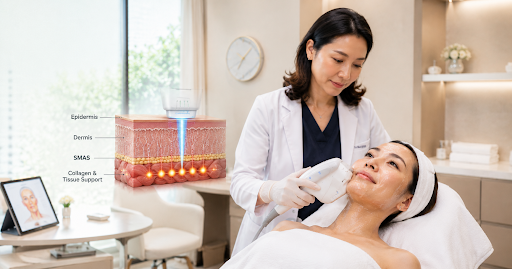
Ultherapy delivers ultrasound energy in focused beams that pass through the skin surface without disturbing it and converge at a precise depth below.
At the focal point, the energy creates a thermal effect — a controlled zone of heating that reaches temperatures between 60 and 70 degrees Celsius within the targeted tissue. At these temperatures, collagen fibres undergo a process called denaturation. The existing collagen contracts and the tissue responds to the thermal injury by initiating a repair process.
That repair process involves the production of new collagen over the following weeks and months. The skin does not simply tighten because something was heated. It tightens because the body builds new structural support in response to the controlled injury signal.
Why Depth Targeting Matters
The precision of the depth targeting is what separates Ultherapy from less specific energy treatments.
Different tissue layers require different treatment depths. The superficial skin layer, the dermis, and the SMAS each respond differently to energy delivery and each contribute differently to facial laxity.
Ultherapy uses imaging to visualise the tissue structure before and during treatment, allowing the practitioner to confirm that energy is being delivered at the correct depth for each area. This real-time visualisation is one of the features that distinguishes it from devices that deliver energy without confirming tissue targeting.
The standard treatment depths are 1.5mm, 3mm, and 4.5mm below the skin surface, corresponding roughly to the superficial dermis, deep dermis, and SMAS layer respectively.
The Collagen Response Timeline
The biological timeline of collagen production explains why results from Ultherapy appear gradually rather than immediately.
| Timeframe | What Is Happening |
| During treatment | Controlled thermal zones created in tissue |
| Week 1 to 4 | Inflammatory response and initial collagen synthesis begins |
| Month 1 to 3 | New collagen fibres forming and organising |
| Month 3 to 6 | Collagen matures and tightening effect becomes visible |
| Month 6 to 12 | Results at peak; gradual natural ageing continues |
This timeline is not a flaw in the treatment. It reflects how the body builds tissue. Trying to accelerate this process further would risk producing results that look less natural or create tissue responses that are harder to control.
What the FDA Clearance Means
Ultherapy holds FDA clearance for non-invasive lifting of the brow, chin, and neck, and for improving lines on the décolletage. FDA clearance in this context required clinical evidence demonstrating that the device does what it claims to do in the specific areas for which clearance was sought.
This matters because many devices in the aesthetic market make similar claims without the same level of clinical documentation. The FDA clearance does not mean Ultherapy produces dramatic results for every patient, but it does mean the mechanism and outcomes have been evaluated against an independent standard.
Limitations Worth Understanding
Ultherapy works well for mild to moderate skin laxity. It does not reposition significantly loose skin the way surgical intervention does. Patients with very advanced laxity, significant volume loss, or heavily sun-damaged skin may find that the collagen response is less pronounced than in patients with better baseline skin quality.
For those researching best ultherapy Singapore options, a consultation with a qualified doctor who can assess tissue quality and laxity grade is the most reliable way to determine whether the treatment is well-matched to the presenting concerns.
Final Thoughts
Ultherapy works through a well-documented biological mechanism. It uses focused ultrasound to create controlled thermal zones at precise tissue depths, stimulating a collagen remodelling response that gradually improves skin firmness and lift.
The science is specific and the clinical evidence base is solid. Understanding that foundation helps anyone evaluating this treatment assess it honestly against their own aesthetic goals.
Meta Title How Ultherapy Works: The Science of Skin Tightening With Ultrasound
Meta Description A clear explanation of how Ultherapy uses focused ultrasound to stimulate collagen production, with the science behind its skin tightening effects.