


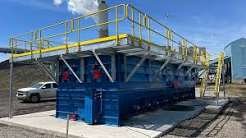
A concrete pit sitting quietly underground feels like a solved problem. Out of sight, out of mind. But for industrial facility managers and environmental compliance officers, it is often a ticking clock. Old, unlined concrete oil-water separators provide a false sense of security to industrial facilities. Over time, these aging vaults degrade, hiding structural flaws that can devastate your operations.
Failing separators trigger severe financial penalties and environmental damage, making an upgrade away from concrete essential. The transition from legacy infrastructure to engineered solutions is a necessary step for long-term facility protection. When aging concrete pits begin to crack and fail, facilities face the immediate threat of groundwater contamination. To mitigate these hidden liabilities, many operators are proactively upgrading to an advanced separation unit designed to guarantee long-term structural integrity and compliance.
In this post, we will break down exactly why old vaults break down and outline the specific return on investment of modernizing. You will learn the hidden signs of failure and discover how modern separation technology keeps your site safe and compliant.
Key Takeaways
- Concrete separators inevitably degrade due to chemical attacks, resulting in structural failure and groundwater contamination.
- The EPA strictly enforces discharge limits, meaning failing infrastructure can quickly lead to massive daily financial penalties.
- Modern fiberglass and stainless steel separation units offer superior protection, sub-10 ppm discharge purity, and long-term warranties.
- Facilities can choose to either fully replace failing systems or retrofit structurally sound pits with drop-in coalescing media.
The Hidden Liabilities of Legacy Concrete Separators
For decades, poured concrete was the default choice for underground wastewater infrastructure. Facility managers inherited these systems, assuming they would last forever. Unfortunately, the harsh reality of industrial wastewater tells a different story. We need to explore exactly why old concrete pits are failing and the massive risks they pose to industrial operations today.
How Wastewater Chemically Degrades Concrete
Why do traditional concrete oil-water separators degrade over time? The answer lies in the aggressive chemistry of industrial effluent interacting with the vault itself. Concrete looks indestructible on the surface. Yet, at the microscopic level, it is highly vulnerable to its environment.
According to materials experts, concrete is an alkaline, permeable material with pores that leave it exposed to chemical deterioration. As wastewater sits in the separator, organic matter breaks down and releases hydrogen sulfide gas. This gas rapidly converts to sulfuric acid, which attacks the concrete matrix, eating away at the walls and floor over years of continuous use.
The hidden signs that a concrete pit is failing are rarely obvious until significant damage is done. You might notice invisible micro-cracks spreading through the walls or heavy sludge clogs that resist basic maintenance. Another major red flag is oil bypass, where hydrocarbons slip past the baffles instead of separating. Eventually, the porous walls weaken enough to allow toxic hydrocarbons to leach directly into the surrounding soil.
The Regulatory and Financial Fallout
What are the financial and legal consequences of a separator leak or discharge violation? When an underground vault fails, the environmental damage rarely stays hidden. Local and federal agencies strictly monitor industrial effluent, and aging baffle pits frequently fail to meet modern Clean Water Act discharge limits.
Failing to meet these standards triggers heavy federal scrutiny. The financial penalties for non-compliance are severe and compound rapidly. The EPA expects facilities to maintain their pollution control equipment proactively. As federal enforcement guidelines detail, negligent Clean Water Act violations can result in fines of $2,500 to $25,000 per day.
If a facility receives subsequent convictions for these violations, those penalties can reach $50,000 per day. Operating an aging, compromised concrete vault is an enormous financial gamble that rapidly drains capital.
What is an Advanced Separation Unit?
What is an advanced separation unit, and how does it differ from a traditional concrete pit? Legacy concrete separators rely on large, open vaults to slowly separate oil and water through basic gravity. They are passive, inefficient, and require massive footprints to work correctly. Modern units take a highly engineered, active approach to treatment.
The core technology behind an advanced separation unit is the High-Efficiency Coalescer (HEC) pack. This system uses a proprietary random-tube matrix designed to maximize internal surface area. As wastewater flows through the media, the random-tube design effectively flushes suspended solids to the bottom of the tank. Simultaneously, it traps tiny hydrocarbon droplets down to 20 microns in size.
These units are precision-engineered around Stokes’ Law to maximize gravity separation efficiency. As the tiny 20-micron oil droplets gather on the coalescing media, they collide and merge into larger drops. This increases their buoyancy, forcing them to quickly rise to the surface for easy skimming.
This engineered process vastly improves effluent discharge quality. Advanced separation units consistently deliver purity metrics of 10 ppm or less, ensuring basic regulatory compliance. For facilities facing stricter local oversight, High-Performance Filter options can drop contamination levels well under 5 ppm.
Comparing Modern Materials to Legacy Concrete
When auditing infrastructure, facility managers need to justify the return on investment for any upgrade. What are the benefits of upgrading to fiberglass or stainless steel over repairing old concrete? You have to directly contrast maintenance requirements, overall lifespan, and compliance factors to see the true value.
Traditional concrete requires frequent, expensive patching and protective coatings that inevitably peel. In contrast, modern fiberglass reinforced plastic (FRP) and stainless steel units are engineered to withstand aggressive wastewater without degrading. They eliminate the constant cycle of temporary repairs.
To clearly illustrate the contrast, consider how these materials perform across key operational metrics:
| Feature | Legacy Concrete | Fiberglass (FRP) | Stainless Steel |
|---|---|---|---|
| Rust & Corrosion Resistance | Low (Susceptible to acid attack) | Extremely High (Chemically inert) | High (Corrosion resistant) |
| Typical Maintenance Time | High (Requires confined space entry, scrubbing) | Low (Easy washdown) | Low (Easy washdown) |
| Structural Warranty | Minimal to None | Up to 30 Years | Up to 30 Years |
| Expected Lifespan | 15–20 Years (with degradation) | 30+ Years | 30+ Years |
The long-term structural integrity of modern units stands out as a massive advantage. Rustproof materials like FRP and stainless steel can carry up to a 30-year structural warranty. This provides incredible peace of mind for operations managers trying to forecast long-term capital expenditures without fear of sudden structural collapse.
Modern designs also lower routine maintenance costs significantly. Traditional concrete pits often require dangerous confined space entries and intense manual labor to clean. Modern units incorporate large manways and lightweight, removable coalescer assemblies. These smart design features make washdowns straightforward, allowing your team to complete maintenance quickly and safely.
Retrofitting vs. Full Replacement: Choosing the Right Path
During a site audit, operators frequently ask a pressing question. Can existing concrete pits be retrofitted, or is a full replacement necessary? The answer depends entirely on the current structural condition of your underground vault.
If your concrete vault maintains its structural integrity and shows no signs of chemical degradation or leaking, you have flexible options. You can use custom drop-in coalescing media packs and fiberglass frames as an immediate upgrade. This retrofitting approach turns an empty concrete box into a highly efficient separator without the high costs of excavation.
Conversely, full replacements are necessary when the concrete vault is structurally compromised. If the concrete is cracked, leaking, or heavily corroded by sulfuric acid, patching it is a waste of money. Facilities can replace failing pits with Above-Grade, Flush-with-Grade, or heavy-duty Below-Grade (HB-Series) units designed for heavy traffic areas.
Modern separation units also offer turnkey customization to fit your specific operational needs. Manufacturers can build these systems with integrated pumps, freeze protection for cold climates, and automated controls. This adaptability makes modern units highly flexible, fitting into any spatial constraint or site layout.
Conclusion
Relying on aging concrete pits is a massive financial and environmental gamble due to inevitable chemical degradation. The science is clear that untreated concrete cannot withstand the corrosive nature of industrial wastewater forever. When these legacy systems fail, the resulting groundwater contamination and EPA fines can cripple a facility.
An advanced separation unit eliminates these hidden liabilities entirely. By upgrading to engineered materials and high-efficiency coalescing media, you guarantee regulatory compliance. You also completely eliminate the threat of structural corrosion, replacing a decaying pit with a system built to last for decades.
Do not wait for a failed EPA inspection to take action. Facility managers must proactively audit their wastewater systems. Consult with separation experts today to explore your upgrade options before you face unexpected downtime, costly soil remediation, or devastating daily fines.