



Key Takeaways
- Tribute gifts can honor a living person, remember someone who has died, or recognize a shared milestone.
- The most meaningful cause usually reflects the honoree’s values, interests, work, or community connections.
- When a family requests donations, their stated preference should guide the decision.
- A brief personal message helps the recipient understand why the gift was made.
- Save the donation confirmation and review the receipt for your records.
A tribute gift is a charitable contribution made to recognize a person, celebrate an important occasion, or remember someone who has died. It gives a birthday, retirement, wedding, memorial, or quiet personal moment a lasting purpose. Those looking for inspiration can visit https://www.savethemusic.org/resources/honor-memorial-giving/ to explore how honor and memorial giving can connect a meaningful personal tribute with support for music education and a cause that matters.
Why Tribute Gifts Feel Personal
A charitable gift can carry meaning beyond its dollar amount because it turns a person’s passions into practical support. A donation to arts education may suit a beloved music teacher. A contribution to a local food program may reflect the generosity of a neighbor who always made sure others were cared for.
Tribute gifts also work in both happy and difficult seasons. They can celebrate a graduate beginning a new chapter, thank a mentor for years of guidance, or honor the memory of a family member. The right gift does not need to be grand. It needs to be thoughtful and appropriate to the person or occasion.
Honor Gifts and Memorial Gifts Are Not the Same
Although the terms are sometimes used interchangeably, they have different meanings:
- Honor gifts recognize a person who is living, such as for a birthday, wedding, retirement, or achievement.
- Memorial gifts remember a person who has died.
- Tribute gifts are the broader term that can describe either type of contribution.
Using the correct wording on a donation form, card, or notification helps avoid confusion. It also ensures that the recipient understands whether the contribution is a celebration or an expression of sympathy.
When a Tribute Gift Makes Sense
A charitable tribute can be used for many occasions, including birthdays, milestone anniversaries, graduations, retirements, weddings, thank-you gifts, memorial services, remembrance anniversaries, and community celebrations. It can also be meaningful when there is no formal event at all.
A simple gift after a friend completes a difficult project, a coach retires, or a family marks a loved one’s birthday after a loss can show care without requiring a large gathering or elaborate present.
How to Choose the Right Cause
Start by thinking about what mattered to the person being honored or remembered. Their favorite activities, professional life, volunteer work, faith community, neighborhood, or personal experiences may point toward a fitting cause.
- Review any wishes expressed by the honoree or family.
- Choose a mission that clearly connects to those wishes.
- Decide whether a local, national, or community-based organization feels most appropriate.
- Visit the organization’s official website to understand its programs and donation process.
- Confirm that it accepts honor or memorial gifts and provides a receipt.
If the gift follows a death, the obituary, funeral home notice, or memorial website may name a preferred charity. That instruction should take priority over personal assumptions about what might be suitable.
What to Do When an Obituary Says “In Lieu of Flowers”
“In lieu of flowers” generally signals that the family would appreciate contributions to a named organization or cause. Follow the requested instructions, including the person’s full name and any notification details requested on the donation form. Guidance on following a family’s wishes for charitable contributions also emphasizes identifying the person being remembered and including contact information so an acknowledgment can reach the family.
If no organization is named, consider asking a close family member, the funeral home, or another trusted contact before making a donation. In some situations, flowers, meals, childcare, transportation, or practical help may be more useful than a charitable gift.
How to Write a Thoughtful Tribute Message
A warm note does not need to be long. Include four simple elements:
- State that a gift was made.
- Name the person being honored or remembered.
- Share why the cause felt fitting.
- Close with a sincere personal thought.
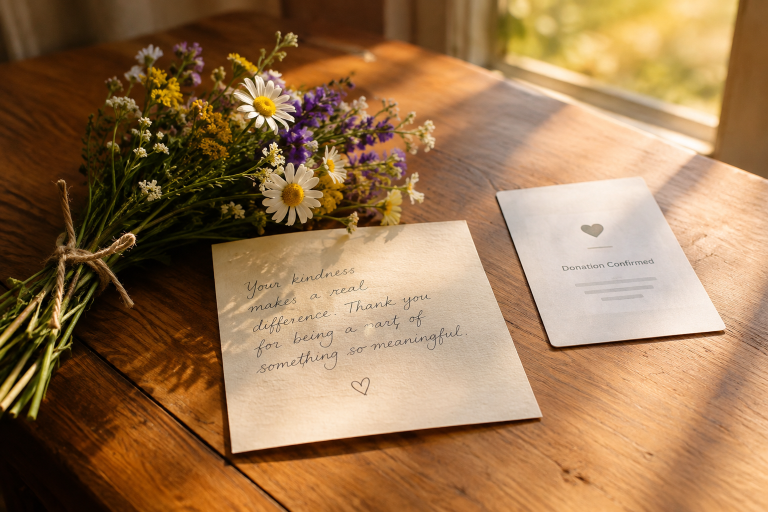
“A donation was made in Jordan’s memory to support programs that reflect his lifelong love of learning. His kindness and curiosity will not be forgotten.”
Unless the recipient already knows and would appreciate the detail, there is usually no need to mention the donation amount. The purpose of the message is to communicate care, not to focus on the size of the gift.
How to Make the Gift Smoothly
- Use the organization’s official donation page.
- Select an honor, memorial, or dedication option if one is available.
- Enter the honoree’s name carefully.
- Add notification information for the honoree or family when requested.
- Write a short message and review it for accuracy.
- Save the confirmation email and receipt.
Double-check names, mailing addresses, and email addresses before submitting the form. Small errors can prevent the notification from reaching the intended person.
Online Gifts, Memorial Funds, and Other Options
A one-time online contribution is often the simplest option, but it is not the only one. A memorial fund can give friends and relatives a shared place to contribute. A recurring gift can create an ongoing tribute. Coworkers, classmates, clubs, and extended families may prefer a group gift, while an in-person contribution may feel right for a local project.
Many charities provide ways for families to direct donations made in memory of a loved one. For example, charitable gifts made in lieu of flowers can give supporters a way to honor a person while contributing to a mission selected by the donor or family.
Questions to Ask Before Donating
- Does the organization accept tribute gifts?
- Will the honoree or family receive a notification?
- Can a personal message be included?
- Will the donation amount remain private?
- Does the organization provide a receipt?
- Does its mission match the person’s values or the family’s request?
How Tribute Gifts Can Support a Lasting Legacy
One tribute gift can be meaningful on its own, and a shared effort can extend that impact further. When many people contribute to the same cause, the gifts may support programs such as education, research, community services, or direct assistance. Online donation forms also make it easier for friends and relatives in different places to participate in one collective remembrance.
Common Mistakes to Avoid
- Ignoring the family’s preferred charity or request.
- Misspelling the honoree’s name.
- Leaving out the family’s contact information when notification is desired.
- Assuming every organization automatically sends an acknowledgment.
- Sharing the donation amount when privacy would be more respectful.
- Choosing a cause without reviewing its mission and current donation process.
Conclusion
A meaningful tribute gift connects a person’s memory, values, or achievements with work that continues beyond the occasion. By respecting family wishes, choosing a cause with care, and adding a personal message, you can create a gesture that feels sincere, useful, and lasting.