



Key Takeaways
- Clear roles help healthcare teams act quickly during high-pressure cardiac emergencies.
- Readiness includes rhythm recognition, airway support, equipment use, communication, and post-event care.
- Simulation drills can reveal gaps in leadership and coordination before a real emergency occurs.
- Technology should support clinical teamwork, not replace it.
- Brief, focused debriefs turn each event into an opportunity to improve.
Table Of Contents
- Why Cardiac Emergency Readiness Matters
- What Should Happen In The First Few Minutes?
- Building Confidence With Rhythm Recognition
- Assigning Clear Roles During A Crisis
- Using Closed-Loop Communication
- Why Simulation Practice Works
- Where Technology Can Support Emergency Teams
- Running A Useful Team Debrief
- Common Readiness Gaps To Watch For
- Final Thoughts
1. Why Cardiac Emergency Readiness Matters
Cardiac emergencies demand more than memorizing an algorithm. Clinicians must assess a changing patient, manage equipment, communicate with colleagues, and make time-sensitive decisions amid interruptions and uncertainty. Structured practice, including an ACLS megacode, gives teams a practical way to rehearse these connected skills before they are needed at the bedside.
Effective readiness also recognizes that the response continues beyond the first intervention. Teams need a shared approach to recognition, resuscitation, reassessment, documentation, handoff, and post-event care. The American Heart Association’s current resuscitation guidance emphasizes high-quality CPR, early defibrillation when appropriate, coordinated systems of care, education, and post-cardiac-arrest treatment.
2. What Should Happen In The First Few Minutes?
The opening minutes should follow the organization’s approved emergency procedures while keeping the patient, not the monitor, at the center of the response.
A Rehearsable Opening Sequence
- Confirm that the area is safe for the patient and team.
- Check responsiveness, breathing, pulse when indicated, and visible signs of deterioration.
- Activate emergency support and bring the appropriate equipment.
- Begin high-quality basic life support when indicated.
- Apply monitoring and prepare for rhythm-based treatment.
- Document times, interventions, rhythm changes, and patient responses.
Fast action is important, but speed without coordination can create avoidable delays. A team leader who assigns tasks early helps ensure that compressions, defibrillator preparation, airway support, medication preparation, and documentation all have an owner.
3. Building Confidence With Rhythm Recognition
Rhythm recognition helps teams select the correct pathway, but it should never replace direct patient assessment. Training should cover broad rhythm groups, including shockable and non-shockable arrest rhythms, slow rhythms associated with poor perfusion, and narrow- or wide-complex fast rhythms. Staff should learn to connect the tracing with the patient’s condition and the applicable clinical protocol.
For every rhythm, teams can pause and ask three questions: Is the patient stable? Is there a pulse? What reversible cause may be contributing? That simple framework discourages monitor fixation and supports more complete clinical thinking.
4. Assigning Clear Roles During A Crisis
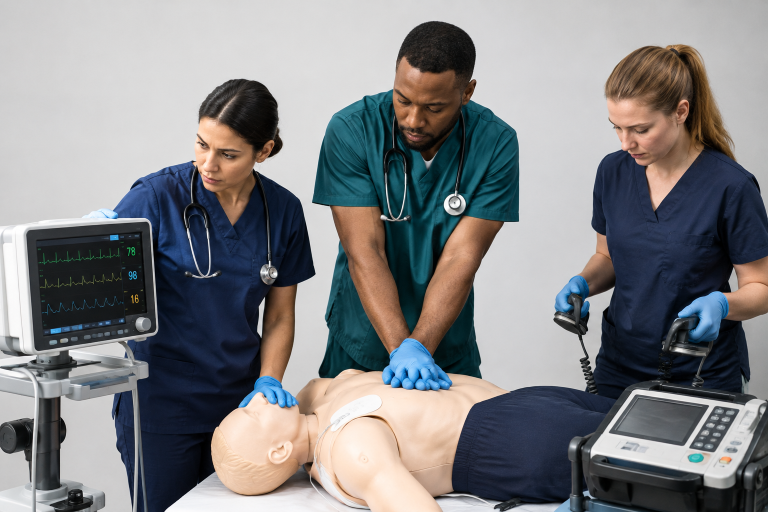
A small team may require people to cover more than one responsibility, but essential tasks still need clear ownership. Common roles include team leader, compressor, airway clinician, monitor or defibrillator operator, medication clinician, recorder, and runner.
Role Checklist
- Name the team leader.
- Assign the first compressor and the relief compressor.
- Identify who will manage the airway.
- Assign monitoring and defibrillator responsibilities.
- Assign medication preparation, administration, and timing.
- Designate a recorder to capture events in real time.
5. Using Closed-Loop Communication
Vague requests invite confusion. “Someone give medication” leaves unanswered questions about responsibility, medication, and timing. A clear request identifies the person, action, order, and expected confirmation. The assigned clinician repeats back the instruction, completes the task, and reports completion to the leader.
Teams can strengthen communication by using names, keeping requests short, repeating medication information, speaking up about safety concerns, and giving concise updates after major changes. Practice with repeat-backs and confirmations can help turn closed-loop communication into a reliable habit during high-acuity events.
6. Why Simulation Practice Works
Simulation lets teams practice technical care and human factors together without putting patients at risk. A useful drill can include a sudden rhythm change, delayed arrival of equipment, airway difficulty, a medication discrepancy, or return of spontaneous circulation followed by a handoff to ongoing care.
In-situ drills, conducted in the actual clinical area, can be especially valuable for identifying practical barriers. Teams may discover that supplies are difficult to locate, alarms are hard to hear, a defibrillator workflow is unfamiliar, or the emergency call process is unclear.
7. Where Technology Can Support Emergency Teams
Digital tools can improve alerting, training, documentation, and performance review when they fit the real workflow. Examples include electronic code alerts, visible timers, event-recording tools, virtual simulation platforms, remote communication with receiving teams, and dashboards that review process measures.
Every tool needs a backup plan. Staff should know how to respond if a device fails, a network is unavailable, or an automated alert does not activate. New technology should be tested during drills before it becomes part of routine emergency response.
8. Running A Useful Team Debrief
A five- to ten-minute debrief can provide meaningful improvement when it focuses on learning rather than blame.
- Review the facts: What happened and when?
- Recognize strengths: What worked well?
- Identify delays: Where did the response lose time?
- Discuss communication: Were requests heard and confirmed?
- Choose one change: What should the team test next time?
Recording one or two specific actions after each drill makes improvement manageable. Small changes, such as relocating equipment or standardizing a callout phrase, can improve the next response.
9. Common Readiness Gaps To Watch For
- No one clearly assumes leadership.
- Several people duplicate one task while another task is missed.
- Medication instructions are not repeated or confirmed.
- Compressor changes are delayed.
- The recorder falls behind.
- Attention stays on the monitor while the patient’s condition is overlooked.
- Post-event care and handoff receive less attention than the arrest response.
- Debriefs are skipped because the team is busy.
Managers and educators can use these observations to create focused practice goals instead of attempting to correct every issue at once.
10. Final Thoughts
Strong cardiac emergency performance is built through repeated practice, defined roles, calm communication, and honest review. Clinical knowledge remains essential, but teams must also rehearse how they will share information, use equipment, recognize change, and continue care after the immediate crisis has passed.