


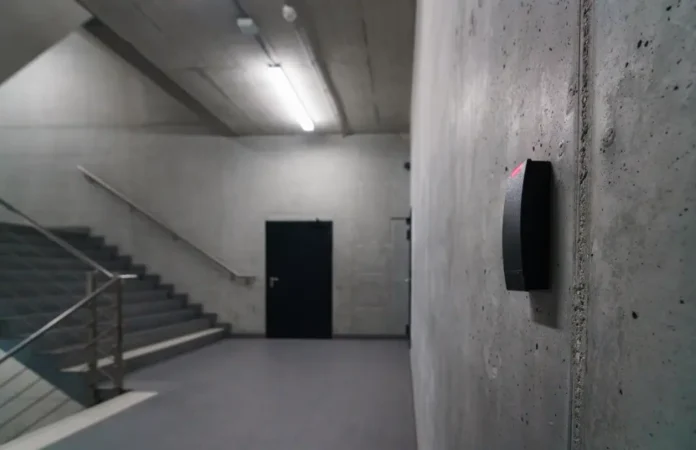
A badge reader on the front door used to be its own self-contained system, wired directly to a control panel in a closet somewhere, managed entirely by whoever installed the alarm system. Most of that is no longer true. Door access systems and security cameras now run over the same network as every laptop and printer in the building, and that single fact changes who is actually responsible for keeping them working and secure.
Physical security became a network device
Modern door access panels connect over Ethernet. Modern cameras stream footage over the same network, often to a cloud service rather than a local recorder. This is genuinely a better architecture in most ways, easier to manage remotely, easier to scale across multiple locations, easier to review footage without physically visiting a server closet.
It also means a known camera vulnerability, a weak password on an access control panel, or an unpatched firmware update on either system is no longer just a physical security problem contained to the device itself. It is a network security problem, with the same potential blast radius as any other compromised device sitting on the company’s network.
Nobody specifically owns this handoff
In a lot of companies, the security integrator who installed the cameras and door panels still manages the physical side, while IT manages everything else. That division made sense when the systems did not talk to each other. It makes much less sense now that both systems share the same network, the same switches, and often the same vulnerabilities.
The Security Industry Association has spent years documenting exactly this shift in its own research on physical and cybersecurity convergence, noting that the two disciplines, once entirely separate professions, now have to coordinate closely because the technology itself has merged even where the organizational responsibility has not caught up.
What gets missed when nobody owns the overlap
Default passwords on camera systems rarely get changed, because the installer configured them once and nobody from IT was ever given access to go back and update them. Firmware updates for door access panels get skipped for the same reason, since neither the security integrator nor the IT team considers patching someone else’s system their job.
These are exactly the kinds of gaps that show up in a basic security assessment, the same kind that a framework like the NIST Cybersecurity Framework is designed to surface by walking through every device connected to a network, not just the ones people think of first when they hear the word computer.
Why this matters more as camera systems get smarter
Newer camera systems increasingly run on-device analytics, facial recognition style features, or cloud-connected storage that raises real questions about data retention and who can access recorded footage. These are not questions a security integrator is typically equipped to answer, because they are IT and data governance questions wearing a physical security disguise.
A company that has never had a conversation between its security vendor and its IT provider is, in practice, running a meaningful piece of its network with nobody accountable for its software side at all.
Bringing both halves of the system under one plan
The fix is not necessarily to make IT install cameras or make a security integrator manage servers. It is to make sure someone is explicitly responsible for the network side of physical security devices, the same way someone is responsible for patching laptops and managing passwords everywhere else on the network.
Businesses evaluating managed IT services Seattle providers offer are increasingly asking this exact question during the sales conversation, because the gap between who installed a device and who is responsible for keeping it secure has become one of the more common blind spots in an otherwise well-run IT environment.