


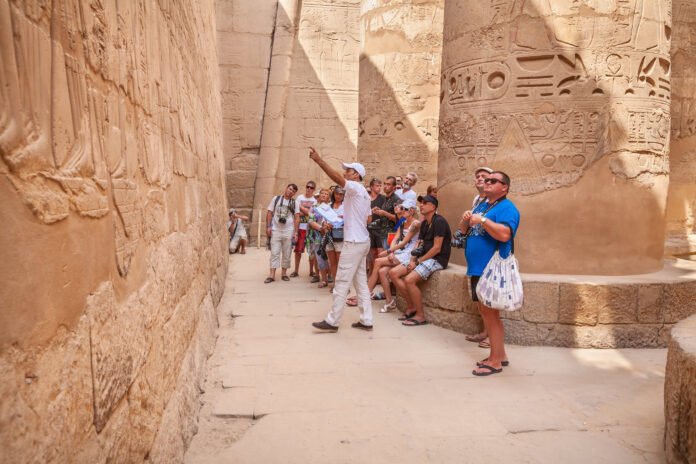
To step into an Ancient Egypt tour with Archaeological Paths is to realise that some places on Earth are not just destinations, they are portals to another version of ourselves. This is a journey that answers the deep call of human curiosity, moving far beyond the surface-level snapshots of typical travel. When you stand in the silent shadow of the Great Pyramid, you aren’t just looking at a monument; you are witnessing the first time humanity dared to build for eternity.
For thousands of years, the world has looked toward the Nile with a mixture of awe and mystery. From the early Greek philosophers to the explorers of the Victorian era, every generation has found its own reflection in the weathered limestone of the Giza Plateau. We travel here in search of the blueprint of the human soul.
The desert is not a graveyard of the past; it is a vibrant laboratory for the modern imagination.
By choosing to explore this landscape through a lens of depth and exclusivity, the traveller transforms from a spectator into a witness. The distance between the 21st century and the Old Kingdom evaporates, leaving only the raw, emotional power of discovery. It is a transition from “touring” to “experiencing,” where every grain of sand has a story to tell to those who are willing to listen.
The Psychology of the Sublime: Why These Stones Still Pull Us
There is a specific mental shift that occurs when a human being encounters something vastly older and larger than themselves. Psychologists call this the “Sublime”, a state where the ego shrinks, and a sense of interconnectedness with history takes over. In the temples of Luxor or the silent chambers of a tomb, this feeling is amplified into a profound silence.
In these spaces, the noise of modern life simply dissolves. You are left with a heavy, sacred stillness that demands reflection. This is why a private archaeological tour approach is so vital for the intellectual seeker. Without the distraction of crowds, your mind is free to wander through the corridors of time.
Why Silence is the Ultimate Luxury
- Deep Focus: Without 500 people in the room, you can actually see the brushstrokes on a 3,000-year-old fresco.
- Emotional Resonance: You form a personal bond with the site that “fast-travel” simply cannot offer.
- Sensory Engagement: You can feel the coolness of the granite and hear the echo of your own footsteps in a King’s chamber.
Decoding the Narrative: The Authority of the Expert
To truly understand the Nile Valley, one must move past the “Golden Mask” version of history found in most guidebooks. The symbols carved into the temple walls are not just art; they are a sophisticated language of the soul. Without an expert to translate this world, the traveller is like someone looking at a library but unable to read the books.
This is where the value of expert-led historical tours becomes life-changing. When a scholar, someone who has spent their life excavating these very sites, points out a specific alignment of a temple with the stars, the stone becomes a scientific instrument.
Working with Archaeological Paths provides this intellectual bridge. Their connection to the world’s leading Egyptologists ensures that every site visited is framed by the latest academic research. It is the difference between hearing a myth and understanding the complex political and religious motives that gave birth to it.
The Anatomy of Experience: A Comparative Study
For the culturally sophisticated traveller, the “how” of the journey is as significant as the “where.” The following table outlines why an intellectual approach creates a more meaningful memory.
| Experience Element | Standard Egypt Tour | Archaeological Paths Experience |
| Guide Knowledge | General tour guide | Expert Egyptologist |
| Access | Public areas only | Restricted & special access sites |
| Learning Depth | Surface-level history | In-depth contextual insights |
| Group Size | Large & noisy | Exclusive, intimate |
| Cultural Insight | Brief, rushed visits | Immersive, reflective |
| Emotional Impact | Simple sightseeing | Awe, reflection, imagination |
The Ethics of Presence: Heritage and Preservation
As global interest in historical travel grows, the conversation around “responsible tourism” becomes more urgent. The monuments of the Nile are non-renewable resources; once they are worn away, they are gone forever. Intellectual travel requires a commitment to the preservation of these sites.
Participating in an Egyptian cultural travel experience means respecting the sanctity of the space. It involves supporting organisations that prioritise conservation and work in harmony with local authorities.
Core Values of Mindful Exploration
- Scholarly Integrity: Prioritising factual depth over sensationalist myths.
- Low-Impact Access: Using private openings to reduce the physical stress of massive crowds on ancient structures.
- Cultural Stewardship: Contributing to the ongoing maintenance of sites through ethical tourism models.
Discovering the Ancient Egypt of the Mind
The greatest wonders of the Nile are not the ones you can photograph, but the ones that stay in your mind long after you have returned home. The Great Pyramid is a feat of engineering, certainly, but it is also a physical manifestation of a dream. It represents the human refusal to be forgotten.
When we explore these sites through luxury Egypt tours, we are essentially buying the mental space required to process these heavy themes. It is difficult to contemplate the nature of the afterlife or the cycles of the sun when you are being rushed through a gift shop.
Archaeological Paths understands that a deep thinker needs time, time to stand in the Temple of Hathor, time to watch the light change on the pillars of Karnak, and time to discuss the nuances of Egyptian mythology with a peer. This is travel as a cultural essay.
The Power of Exclusive Access: Stepping Behind the Veil
One of the most profound elements of a high-end archaeological journey is the ability to enter areas that are strictly off-limits to the general public. This isn’t just about status; it’s about the quality of the interaction with history.
Moments That Redefine Travel
- The Sphinx Enclosure: Standing between the paws of the Great Sphinx, away from the barricades, creates a sense of intimacy that is impossible to describe.
- Private Pyramid Entry: Entering the King’s Chamber in total silence allows the acoustic and spiritual power of the space to be felt in its rawest form.
- Active Dig Sites: Seeing archaeology in progress provides a “behind-the-scenes” look at how history is literally being unearthed in real-time.
These moments of private archaeological tours are what define the mission. They provide the “keys to the kingdom,” allowing the intellectual traveller to step behind the curtain of time.
Conclusion: The Eternal Dialogue
In the end, we go to the desert to find what is permanent within ourselves. The stones of the Nile serve as a reminder that while the forms of civilisation change, the human heart remains consistent in its quest for meaning. To conclude an Ancient Egypt tour is not to finish a book, but to begin a new chapter of understanding.
By walking in the footsteps of the Pharaohs, we realise that we are part of a continuous chain of imagination that spans millennia. Through the lens of Archaeological Paths, the past is no longer a foreign country; it is a homecoming to the very essence of what it means to be human.
Frequently Asked Questions
How does an expert-led tour differ from a standard sightseeing trip?
An expert-led historical tour experience provides academic depth and scholarly context that basic sightseeing simply cannot offer.
What is the significance of “private access” in archaeological travel?
Private access creates a quiet, reflective atmosphere essential for processing the profound spiritual and historical weight of the monuments.
Why is Ancient Egypt considered a “mirror” for modern identity?
The Egyptians explored universal themes like legacy and mortality, providing a lens to better understand our own modern aspirations.
What defines a true Egyptian cultural travel experience?
It is defined by deep immersion into the philosophy, art, and social structure of the civilisation rather than just visiting landmarks.
Are luxury Egypt tours focused only on high-end comfort?
While comfort is included, the true luxury lies in exclusive access, expert guidance, and the time allowed for intellectual reflection.