


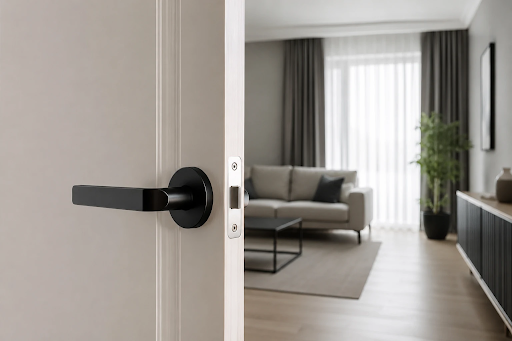
When designing a quieter home, many people invest in thicker walls, better insulation, or acoustic panels, yet overlook the biggest weak point in the room: the interior door. Even a beautifully finished room can lose much of its acoustic privacy if sound easily escapes through lightweight door panels and small air gaps.
If you are looking for premium Modern Interior Doors by Indigo Doors in Florida, consider browsing the complete collection at https://indigodoors.com/products/interior-doors/. Their selection combines modern aesthetics with durable construction, making it an excellent choice for homeowners who want stylish interior spaces while upgrading overall door quality.
Whether you are creating a peaceful bedroom, a productive home office, or a private media room, understanding how sound travels through a door allows you to choose improvements that actually make a noticeable difference.
Why Interior Doors Allow So Much Noise
Many homeowners assume the door itself is responsible for every sound problem. In reality, the biggest culprit is often the air surrounding the door.
A hollow-core interior door contains very little dense material, making it easy for sound vibrations to pass through. At the same time, even tiny openings around the frame or beneath the threshold create direct pathways for airborne sound. Professional acoustic engineers frequently describe these openings as the weakest part of the entire wall assembly because sound naturally follows the path of least resistance.
The most expensive door cannot provide good sound isolation if air gaps remain around its perimeter. Airtight sealing is just as important as the door itself.
This principle explains why replacing only the door sometimes produces disappointing results. The entire system, including the frame, threshold, hinges, and surrounding construction, contributes to acoustic performance.
The Most Effective Ways to Improve Sound Isolation
No single modification works perfectly in every situation. Instead, combining several improvements produces far greater results than relying on one upgrade alone.
- Replace a hollow-core door with a solid-core model, which offers significantly greater mass and blocks far more airborne sound;
- Install high-quality perimeter seals and an automatic door sweep or threshold seal to eliminate sound leaks around the edges;
- Increase the existing door’s mass with specialized acoustic materials if replacing the door is not currently possible;
- Inspect the frame carefully and seal any gaps using acoustic sealant rather than standard household caulk;
- Reduce reflected sound inside the room using carpets, curtains, upholstered furniture, or acoustic wall treatments where appropriate.
These improvements complement one another because each addresses a different aspect of sound transmission.
Comparing Common Soundproofing Solutions
| Solution | Expected Improvement | Cost Level | Difficulty |
| Solid-core door replacement | Excellent | High | Medium |
| Acoustic perimeter seals | High | Low | Easy |
| Automatic door sweep | High | Low | Easy |
| Mass-loaded acoustic barrier | Moderate | Medium | Medium |
| Decorative acoustic panels | Moderate | Medium | Easy |
| Heavy curtains near the doorway | Small to Moderate | Low | Easy |
The table also illustrates an important reality. Some of the least expensive upgrades, especially sealing gaps around the frame, often provide one of the highest returns on investment.
Understanding STC Ratings
When comparing doors, many manufacturers reference an STC value, or Sound Transmission Class. This number measures how effectively a construction assembly reduces airborne sound.
Typical hollow-core interior doors generally achieve relatively low acoustic ratings, while solid-core doors perform noticeably better. Doors specifically engineered for acoustic applications can achieve even higher ratings, but their full performance depends on proper installation and complete perimeter sealing. Installing a premium acoustic door inside a poorly sealed frame wastes much of its potential.
Soundproofing should always be viewed as a complete system. Walls, doors, ceilings, flooring, and even ventilation openings work together to determine the final result.
This explains why professional recording studios, medical offices, and conference rooms pay careful attention not only to the door slab but also to every surrounding detail.
Mistakes That Often Waste Money
Many products promise dramatic reductions in household noise, yet not all of them address the actual problem.
- Installing acoustic foam directly onto a hollow door while ignoring the large gap underneath it;
- Purchasing a heavy decorative door without sealing the frame;
- Using ordinary weatherstripping that compresses unevenly or wears out quickly;
- Expecting paint, wallpaper, or decorative finishes to noticeably improve sound insulation;
- Forgetting that adjacent walls or shared ventilation systems may transmit sound even after the door has been upgraded.
One of the biggest misconceptions is believing that acoustic foam blocks sound. In reality, most foam primarily reduces echo inside the room rather than preventing sound from traveling through the door itself.
My Professional Assessment
After reviewing current recommendations from acoustic engineers and building specialists, one conclusion appears consistently across nearly every reliable source: mass and airtightness outperform gimmicks.
Many homeowners spend money on decorative products because they appear impressive, yet measurable improvements usually come from much simpler upgrades. Replacing a hollow-core door with a solid-core model and sealing every perimeter gap often transforms speech privacy more than adding expensive acoustic decorations throughout the room.
For most homes, the best balance between cost and performance comes from combining a solid-core interior door with quality acoustic seals and a properly fitted bottom sweep.
Only in situations requiring exceptional privacy, such as music studios, therapy offices, or dedicated home theaters, does it become worthwhile to invest in specialized acoustic-rated door systems. For ordinary residential spaces, careful installation and attention to sealing details generally provide the greatest improvement per dollar spent.
Ultimately, reducing noise through an interior door is less about finding a miracle product and more about understanding how sound behaves. When every small leak is addressed and the door itself has sufficient mass, even an ordinary room can become noticeably quieter, more comfortable, and far more private.