


Table Of Contents
- Why Screen-Free Time Matters
- What Makes Puzzles Useful?
- How To Choose The Right Puzzle
- How To Build A Daily Routine
- How To Keep The Habit Enjoyable
- Ways To Make Puzzle Time Social
- Keeping Brain-Health Claims Realistic
- A Simple Seven-Day Starter Plan
- Final Thoughts
Many spare moments disappear into automatic scrolling. A quick check during breakfast, a few minutes while waiting for dinner, or a break between tasks can easily turn into more screen time than intended. Replacing every digital habit is not necessary, but adding one small offline option can make those in-between moments feel more deliberate.
A puzzle is a practical place to start because it gives your attention one clear task and a natural stopping point. For accessible options in several formats, follow this website and choose a puzzle that feels inviting rather than intimidating. The goal is not a perfect streak or a major lifestyle overhaul. It is a short, repeatable activity that helps create a calmer break in the day.
Why Screen-Free Time Matters
Screen-free time can create a useful transition between work, chores, exercise, and rest. Instead of moving straight from one demand to another with a feed in hand, you can spend a few minutes on an activity that has a beginning, middle, and end. That small boundary can make it easier to notice when you are taking a break instead of simply filling time.
Puzzle time works well because you can tailor it to the moment. Solve one clue while your coffee brews, finish a number grid after lunch, or settle in for a longer challenge on a quiet evening. The best format isn’t the one that seems most impressive—it’s the one you’ll be glad to pick up again tomorrow.
What Makes Puzzles Useful?
Puzzles ask you to focus on a specific problem, whether that means finding a word, identifying a pattern, fitting pieces together, or working through a clue. Unlike an endless feed, most puzzles offer visible progress and a clear place to pause. They also require very little preparation: a pencil, a printed page, and a few available minutes may be enough.
- They can fit short breaks or longer periods of quiet time.
- They offer choices for different interests, from words and trivia to numbers and visual patterns.
- They can be enjoyed alone, alongside someone else, or as a shared activity.
- They provide manageable challenges without requiring a large commitment.
How To Choose The Right Puzzle
Choosing a puzzle becomes easier when you match it to your available time, energy, and mood. An activity that feels satisfying when you are alert may feel frustrating at the end of a demanding day, so keep more than one option available.
Match The Puzzle To Available Time
- Five minutes: Try a mini crossword, short word search, or simple number grid.
- Fifteen minutes: Work through several crossword clues, a logic puzzle, or a themed word challenge.
- Thirty minutes or more: Choose a larger puzzle, a multi-step logic challenge, or an activity you can solve with another person.
Match The Puzzle To Your Mood
- Choose word puzzles if you enjoy language, clues, and general knowledge.
- Choose number puzzles if clear rules and orderly patterns feel relaxing.
- Choose logic puzzles when you want a careful, step-by-step challenge.
- Choose coloring, spot-the-difference, or other visual activities when you want a slower pace.
How To Build A Daily Routine
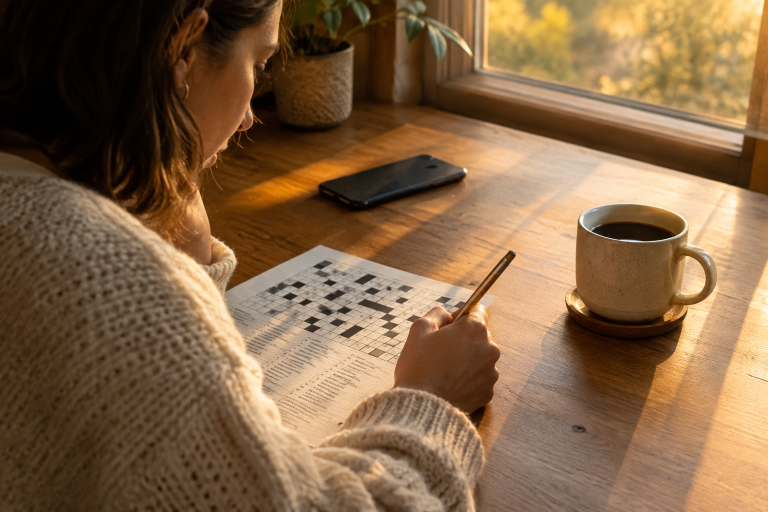
A lasting habit usually needs less motivation than convenience. Start by connecting puzzle time to something that already happens in your day, such as morning coffee, a lunch break, the train ride home, or the time after dinner.
- Pick one daily cue. Use the same moment whenever possible.
- Begin with five or ten minutes. Make the goal to start, not to finish an entire page.
- Keep supplies visible. Store pencils, glasses, and puzzle books in one easy-to-reach spot.
- Remove one distraction. Silence notifications or leave the phone in another room.
- Track sessions, not scores. A calendar checkmark is enough to show that you showed up.
How To Keep The Habit Enjoyable
Enjoyment matters more than difficulty. If a puzzle repeatedly leaves you annoyed, switch formats, reduce the challenge, or take a break. Keeping an easier option nearby is especially helpful on busy days, while a more difficult puzzle can be saved for a weekend morning or a quiet evening.
Variety also prevents the habit from feeling like homework. Rotate among word, number, logic, and visual puzzles. Look for themes related to travel, food, history, sports, hobbies, or subjects you already enjoy. A puzzle session does not need to prove anything. It only needs to be engaging enough to replace a few minutes of mindless scrolling.
Ways To Make Puzzle Time Social
Puzzles can support conversation without turning every gathering into a competition. Try setting aside one screen-free evening each week, letting each person choose a comfortable level of challenge, and offering hints instead of immediately giving answers. Comparing different approaches to a clue can be as enjoyable as solving it.
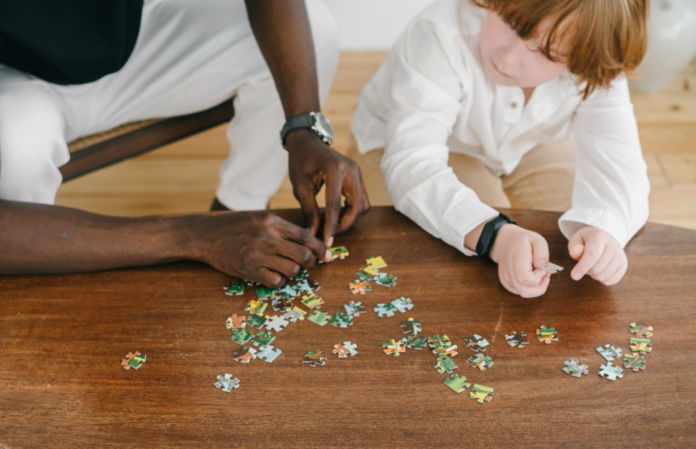
For parents and children, shared puzzle time can also be a chance to use patient guidance. A recent study of parent-child puzzle sessions reported that pairing spoken guidance with gestures was associated with stronger engagement during problem-solving. In practice, that can mean pointing to a relevant piece, demonstrating one possible move, or asking a simple question before stepping in.
Keeping Brain-Health Claims Realistic
Puzzles can provide mental engagement and a focused alternative to passive screen use, but they should not be presented as a guaranteed way to prevent dementia, restore memory, or treat a medical condition. Research on cognitive health is complex, and one pastime cannot replace medical care or the broader habits that support overall well-being.
The National Institute on Aging notes that evidence about preventing cognitive decline and dementia remains incomplete, while encouraging a wider approach that includes health care, physical activity, social connection, and other healthy choices. Keep claims about puzzles practical: they may support a routine of mentally stimulating activity, but they are not a cure or a promise of sharper memory for every person.
A Simple Seven-Day Starter Plan
- Day One: Complete an easy puzzle for five minutes.
- Day Two: Repeat it at the same time of day.
- Day Three: Try a different puzzle type.
- Day Four: Solve alongside a friend or family member.
- Day Five: Do one puzzle before opening a social media app.
- Day Six: Set aside twenty minutes for a longer challenge.
- Day Seven: Notice which format and time felt easiest to repeat.
Final Thoughts
A screen-free puzzle habit can begin with one page and a few quiet minutes. Choose activities you genuinely enjoy, keep the setup simple, and allow the routine to develop at a comfortable pace. The aim is not to eliminate technology or maintain a flawless streak. It is to make a little more room for focused, enjoyable time offline.