


Common Mistakes in PhD Proposals that Lead to Rejection (and How to Fix Them)
The journey to a doctorate is often described as a marathon, but the research proposal is the heavy iron gate you must unlock before you even step onto the track. For many aspiring scholars, this document is the most stressful part of the entire academic career. You have the passion, you have the grades, and you have a vision for how you want to change your field. Yet, year after year, brilliant students face the stinging “desk rejection” because of avoidable structural flaws. It isn’t always about your intelligence; often, it’s about how you package your ideas for an audience that values feasibility just as much as innovation.
When you are deep in the trenches of drafting your proposal, it is easy to lose sight of the bigger picture. Many students find themselves overwhelmed by the sheer volume of technical requirements, leading them to look for professional assignment writing online to see how experts structure high-level academic documents. Using a service like myassignmenthelp can provide a clear template or an edited draft that ensures your tone remains formal and your citations are flawless. Understanding these professional standards early on is a great way to ensure that your proposal reads like the work of a seasoned researcher rather than a confused student.
1. The “Kitchen Sink” Syndrome: Narrowing Your Scope
One of the most frequent reasons a PhD proposal hits the rejection pile is that the topic is simply too broad. This is what we call the “Kitchen Sink” syndrome—trying to solve every problem in your industry within a single three-year project. Professors aren’t looking for a researcher who wants to “solve world hunger” or “fix the global economy.” They are looking for a specialist who wants to investigate a very specific, manageable niche.
If your proposal title is “A Study of Digital Marketing Trends,” it will likely be rejected for being vague. However, if you change it to “The Impact of Short-Form Video Content on Gen Z Brand Loyalty in the UK Fashion Industry (2024-2026),” you suddenly have a project that is measurable and realistic. A narrow scope allows you to go deep into the data, which is the hallmark of a successful doctorate. Remember, a PhD is about making a “significant original contribution,” and it is much easier to be original in a small, unexplored corner than in a massive, crowded field.
2. The Misalignment of Aims and Questions
Imagine building a house where the blueprint shows a kitchen, but the foundation is poured for a garage. That is exactly what happens when your research aims don’t match your research questions. This lack of logical “flow” is a major red flag for admissions committees. Your Research Aim is your destination (what you want to achieve), while your Research Questions are the vehicle that gets you there.
To fix this, try writing them out in a simple table. If your aim is to identify the causes of teacher burnout, but your research question asks how many teachers are leaving the profession, you have a mismatch. One is looking for “why” (causality), while the other is looking for “how many” (description). Aligning these elements shows the committee that you have a logical mind and a clear plan of action.
3. Ignoring the “Feasibility” Factor
You might have the most groundbreaking idea in the world, but if you cannot prove that you can finish it in three years, it will be rejected. This is where most students fail. They propose projects that require access to high-level government officials, expensive laboratory equipment they don’t have, or a sample size of 10,000 people without a budget.
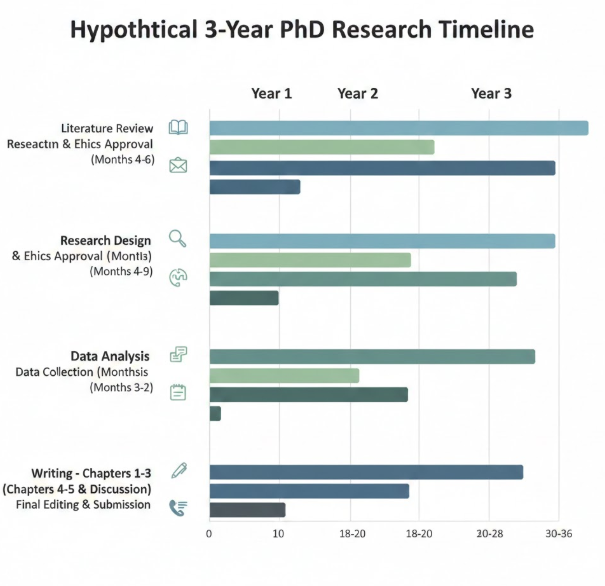
A successful proposal includes a realistic timeline, often presented as a Gantt chart. You need to show that you have considered the “boring” parts of research: ethical approvals, data cleaning, and the inevitable delays of the writing process. If you are writing a complex economics assignment or a financial thesis, you must specify exactly which datasets you will use and whether they are publicly available. For example, relying on “interviews with bank CEOs” is risky because they might not talk to you; relying on “World Bank Open Data” is feasible.
4. The Literature Review: A Gap, Not a Summary
Many students treat the literature review like a high school book report—a list of who said what. A PhD-level literature review needs to be much more aggressive. It shouldn’t just summarize existing work; it should find the “gap” where those works failed. Your job is to prove that there is a hole in our current knowledge and that your research is the only thing that can fill it.
If you just list twenty authors who agree with each other, the committee will wonder why your research is necessary. Instead, look for contradictions. Author A says social media is good for mental health, but Author B says it is bad. This disagreement is your “gap.” By positioning your work as the “tie-breaker” or the “new perspective,” you give the university a reason to fund you.
5. Methodology: The “How” is More Important Than the “What”
The methodology section is often the weakest part of a proposal because students are afraid of the technical details. They might say, “I will use qualitative interviews,” and leave it at that. That isn’t enough. You need to explain:
- How many people will you interview?
- How will you find them (sampling strategy)?
- What specific software (like NVivo or SPSS) will you use for analysis?
- How will you ensure the data is valid and reliable?
Think of the methodology as a recipe. If someone else followed your instructions, would they get the same result? If the answer is no, your methodology is too vague.
6. Poor Tone and Academic Integrity
Even the best ideas can be ruined by “sloppy” writing. In 2026, with the rise of AI tools, universities are hyper-sensitive to “robotic” writing. If your proposal sounds like it was generated by a machine, it will be rejected instantly. Academic writing should be formal, but it should also show your “voice”—your ability to argue, critique, and synthesize complex ideas.
Furthermore, citation errors are a death sentence for a proposal. Using the wrong version of APA or Harvard style suggests a lack of attention to detail. This is where many students use professional editing services to double-check their bibliographies. A clean, perfectly formatted document tells the committee that you are ready for the professional rigors of a PhD.
7. Failing to Explain the “So What?”
Finally, many proposals are rejected because they fail to explain why the research matters. This is the “Significance” section. Even if your research is technically perfect, if it doesn’t solve a problem or advance a theory, it lacks “impact.”
Will your work influence government policy? Will it help businesses save money? Will it provide a new framework for understanding human behavior? You must sell the value of your work. You aren’t just asking for a degree; you are asking the university to invest in your brain. Make sure they know what the return on that investment will be.
Conclusion: Your Roadmap to Acceptance
A PhD proposal isn’t a hurdle meant to trip you up; it’s a tool to help you succeed. By narrowing your scope, aligning your questions, and proving your project is feasible, you move from being an “applicant” to being a “colleague.”
Frequently Asked Questions
What is the ideal length for a PhD research proposal?
While requirements vary by department, a standard proposal is typically between 2,000 and 3,000 words. It must be long enough to demonstrate a deep understanding of the literature but concise enough to show you can focus on a specific research problem.
How specific should my research questions be?
Your questions should be narrow and answerable within your timeframe. Avoid “yes/no” questions; instead, use open-ended starters like “To what extent…” or “In what ways…” to allow for the complex analysis required at the doctoral level.
Do I need a complete bibliography in the initial proposal?
Yes. You must include a preliminary reference list formatted in your field’s required style (e.g., APA, Harvard, or MLA). This proves to the admissions committee that you have already engaged with the foundational texts and current debates in your niche.
Can I change my research topic after the proposal is accepted?
It is common for a project to evolve as you gather data, but the core “problem” usually remains the same. Minor shifts in focus are expected, but a total change in topic may require a formal re-approval process by your doctoral committee.
About the Author
Emma Jones is an academic consultant and educational strategist dedicated to helping students navigate the complexities of higher education. With a focus on research methodology and structural clarity, Emma collaborates with the team at MyAssignmentHelp to produce high-level resources that empower scholars to reach their full potential.