


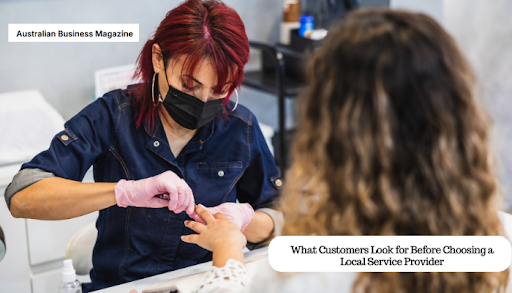
Customers look for trust, proof of past work, and fast responses before choosing a local service provider.
But most businesses only cover one or two of those signals. You might have great reviews but no proof of the work itself, or plenty of before-and-afters with nothing backing up whether you’re reliable. Either way, that gap is often what sends a customer to a competitor instead.
At AB Mag, we see this play out across small businesses constantly: good work, average online presence, and lost jobs. So we put this together to walk you through what customers check before they decide, and what you can do about it.
Read on to see how fast that decision actually happens.
Local Customers Make Up Their Minds Quickly
A lot of local customers quickly decide on a provider, often within a day. That’s mainly because most people aren’t looking to spend hours on the decision-making process.
They have a problem to solve and want a reliable person to fix it. So they scan a few options, look for signs they can trust, and go with whoever looks safest.

That puts a lot of weight on first impressions. And for most local providers, customers form relationships with them entirely online before any conversation takes place.
Trust Comes Before Price
When a job goes elsewhere, many local providers think they were undercut on price. But customers usually place trust above price. Sure, they’ll check the price and move forward if it fits their budget. However, they’ll usually leave if something feels off, even when the quote is competitive.
So, think about it from the customer’s side. If two businesses show up in a search and one looks more credible with better reviews, most people will spend a little more to go with that one.
This is where a lot of local providers lose ground to competitors. They focus on being competitive on price when the real gap is how credible they appear before a customer ever reaches out. Building that credibility early is often what influences the final decision.
Online Reputation: What Customers Actually Read
A customer might not spend long on your page, but they do check whether your business looks credible. Most of the time, that comes down to three things: your star rating, what the reviews say, and whether you’ve responded to them.
We cover each one in detail below.
Reviews and Ratings
One of the first things customers check when judging a business is its reviews and ratings. A strong rating builds immediate confidence, while a weak one sends them straight to the next option. Maybe that’s why 57% of consumers won’t use a provider rated below 4 stars.
But the rating itself is only part of the picture. Customers also look at the reviews behind the score. A larger number of reviews can build confidence because it shows a company has experience serving people.
There’s another factor they consider, though: how recent that feedback is. If the latest one was from a year ago, potential customers may question whether the provider is operating at the same level. Fresh, specific feedback, on the other hand, shows a company that is active, reliable, and worth calling.
Your Responses to Reviews
Plenty of businesses get a review and never reply. It might seem harmless, but future customers are reading that exchange just as closely, especially the negative ones. How a provider handles a complaint in public says more than the complaint itself.
When you handle it well, it tells them the company takes its work seriously. Silence sends a message too, just not the one you want. Staying on top of responses is one of the simplest ways to protect your reputation without spending a cent.
First Contact Sets the Tone
Most customers reach out to more than one business at a time. Whoever replies first is often already ahead before the others even see the enquiry. In fact, 53% of consumers hire the first provider that responds to them.
Speed without substance doesn’t hold up, though. A message like “Thanks for reaching out, we’ll get back to you soon” acknowledges the enquiry but gives the customer no reason to wait. A stronger reply explains what happens next, sets expectations, and gives them enough information to move forward.
Something like: “We can look at this Thursday. It’s usually a $150–250 job depending on what we find. Here’s how booking works.”
Pro Tip: Create a simple response template that covers the basics, then personalise it for each enquiry. That way, you can keep the speed advantage without sacrificing the detail customers need.
What Your Online Presence Needs to Do
Your online presence needs to do two things: show evidence that the work is real, and make it easy for someone to contact you.
Here’s what each of those looks like in practice.
Proof That the Work Is Real
You don’t need a fancy website to show customers you’re the right call. A few specific details can give potential buyers something concrete to judge your business against. This could be real project photos, the areas you serve, or clear descriptions of the work you offer.
Say you run a plumbing business in Fitzroy and your homepage shows a recent burst pipe repair with photos and a short description of the job. That tells a nearby customer far more than a site that just says “we service all Melbourne suburbs.” The first shows you’ve handled similar work nearby, while the second gives customers little to judge you on.
From what we’ve heard from local providers, suburb-specific job photos tend to attract more relevant enquiries than stock imagery. That level of detail helps customers see that you’re familiar with their type of project before they reach out.
Making It Easy to Take the Next Step
This is where a lot of online presences fall short. A customer lands on your page, likes what they see, but can’t find a phone number or a clear way to get a quote. So they leave and try an alternative.
To avoid this, keep a phone number, a contact form, and a quick line on what happens next, all visible on your homepage. These small details remove the friction that stops users from taking the next step.
Word-of-Mouth Has Moved Online
Referrals still drive local service bookings, but the way people share and discover those recommendations has changed. This is what that shift looks like:
| Where It Used to Happen | Where It Happens Now |
| A neighbour’s recommendation over the fence | Local Facebook group post |
| A friend’s suggestion at a BBQ | Google review from a past customer |
| A colleague’s referral at work | Nextdoor community recommendation |
| A family member’s advice over the phone | Public forum or community group post |
Notice the shift? The channel changed, but the habit behind it didn’t. People still ask someone they trust before they book a service. They just do it in a comment section now instead of a driveway.
For local providers, that means your online reputation has become your word-of-mouth, and it deserves the same care as any personal recommendation.
Making Your Business the Right Choice
By the time customers reach out, they’ve already formed an opinion. They’ve checked your star rating, skimmed a few reviews, seen how you respond, and sized up your homepage. In most cases, the decision is close to being made before you ever hear from them.
Fortunately, none of this takes a big budget or a full overhaul. A strong Google rating, a handful of recent testimonials, and fast replies are usually enough to earn that trust (and most cost nothing to implement).
If you found this useful, explore more of our small business guides at AB Mag.
FAQs About Choosing a Local Service Provider
We get a lot of questions about what drives customer decisions at the local level. Below are some of the questions we hear most often.
What role does buying behaviour play in local service decisions?
Buying behaviour plays a speed-driven role in local service decisions, since most people treat the choice as low-risk rather than a big investment. Once someone looks trustworthy enough, buyers tend to act on that impression instead of digging further or comparing extra options.
What does the customer journey look like after someone books a provider?
After booking, the customer journey shifts from comparing options to watching how the job goes. They notice things like whether you show up on time, follow through on what was promised, and communicate along the way.
That experience is what decides whether they leave a review, recommend you to someone else, or come back next time.
How do purchasing decisions change when the job is urgent?
Purchasing decisions move faster when the job can’t wait, such as a burst pipe or a broken lock. Customers often skip most of the comparison process and go with whoever looks available and credible right away, sometimes without checking reviews at all.
For non-urgent jobs, they’re more likely to compare several options before making a decision.