


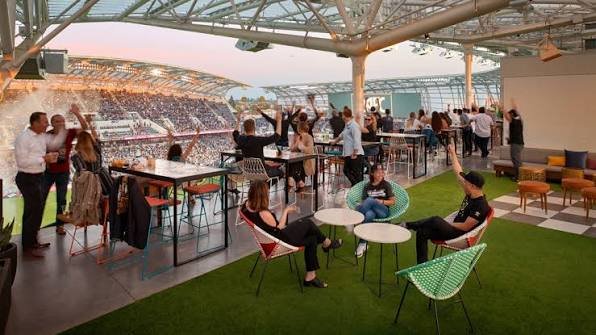
Here’s a claim that makes finance teams wince: the room you pick matters more than the agenda you plan. Companies pour weeks into speaker lineups, breakout topics, and slide decks, then book whatever conference space is cheapest and closest, as if the setting were an afterthought. That order of priorities is backward, and it quietly undermines the very outcomes these events are supposed to produce.
The instinct is understandable. A venue feels like logistics, and logistics feel like a cost to minimize. But the space isn’t neutral. It shapes how people show up, how they behave once they’re there, and what they carry away. Treating it as a line item to trim is like treating the stage as an irrelevant detail of a concert. Everyone would notice, even if nobody could name why.
Does the room really change behavior?
Yes, and the effect is larger than most people assume. Environmental psychology has spent decades documenting how physical space alters mood, attention, and social behavior, and the findings are consistent. Natural light improves alertness and mood. Ceiling height influences how abstractly people think, with taller rooms nudging toward more expansive ideas. Cramped, windowless spaces do the opposite, and everyone has felt it during hour six of a meeting in a beige box.
This is why the choice of a NYC corporate event venue deserves the same rigor a company applies to hiring or vendor selection. When a team gathers somewhere with light, air, and a sense of occasion, the meeting inherits that energy. When they gather somewhere forgettable, the content has to fight the setting instead of being lifted by it. A strong space doesn’t guarantee a good event, but a bad one caps how good the event can be, no matter how sharp the agenda.
Isn’t a distinctive venue just an expensive vanity play?
This is the objection that kills more good venue decisions than any other, and it deserves a real answer rather than a dismissal.
The critique has a point at the extremes. A company spending lavishly on a space purely to impress, with no connection to any business goal, is wasting money, and no amount of skyline justifies it. Vanity spending is real. But the “vanity” label gets slapped on decisions that are actually strategic, and that’s the error worth correcting.
Think about what a corporate event is trying to accomplish. A recruiting dinner exists to convince talented people that this is a serious, appealing place to work. A client event exists to deepen relationships that carry real revenue. A leadership offsite exists to produce alignment and ideas the daily grind never allows. In every case, the environment is doing persuasive and psychological work directly tied to the goal. A candidate weighing offers reads signals everywhere, and where you host them is one of the loudest. That’s not vanity. That’s the message.
There’s also the plain matter of return. If an offsite pulls thirty senior people out of their jobs for two days, the fully loaded cost of their time dwarfs the venue fee. Spending a little more on a space that actually produces breakthroughs, rather than a cheap room that produces a collective urge to check email, is the frugal choice, not the extravagant one. The expensive mistake is a forgettable event, whatever it cost.
What about remote work? Do in-person events still matter?
The rise of distributed teams was supposed to make physical gatherings obsolete. It did the opposite. When people rarely share a room, the times they do carry far more weight, and companies have noticed.
For a workforce spread across cities or working from home most of the year, the in-person event is no longer routine. It’s the rare, concentrated dose of the things video calls can’t deliver: unscheduled conversation, real rapport, the sense of belonging to something with a physical presence. Squandering that scarce opportunity on a dull venue is a genuine loss. You don’t get many chances to make the team feel like a team, and the setting is part of how that feeling gets built.
This shift also changes the economics. A company that saves on office space by going remote has room in the budget to invest in the moments when everyone convenes. Redirecting some of that saving toward events that actually land is one of the more sensible trades available to a modern organization, and the ones getting it right treat their occasional gatherings as flagship experiences rather than obligations.
How should companies actually choose, then?
If the venue matters this much, the selection process should reflect it. A few principles help.
Start from the outcome, not the address. Define what the event needs to achieve, then ask what kind of environment serves that goal. A high-energy launch, a focused strategy session, and a relationship-building dinner want different spaces, and the same room rarely serves all three well.
Weigh the full experience, not the photo. A striking space that can’t handle your headcount, feed your guests well, or support your presentation is a liability dressed up as an asset. The venues worth booking pair the memorable setting with the unglamorous fundamentals, real catering, working audiovisual, staff who have done this before.
Account for the total cost of the event, including the value of everyone’s time, before deciding the venue is where to economize. Cutting the space to save a modest sum while spending vastly more on the people in it is a false economy that shows up in the results.
And factor in what the event says about the company, because it says something whether you intend it to or not. The choice signals to employees how much they’re valued, to clients how the firm operates, to recruits what kind of place they’d be joining. Those signals have a price when you ignore them.
It helps to remember that people rarely recall the specifics of an agenda a month later. They recall how the day felt, where they were standing when a good conversation happened, whether the whole thing seemed considered or thrown together. That memory is the real deliverable, and the space is where it forms. Skimp on the setting and you’re economizing on the one part of the event that actually lasts.
The reframe worth adopting
None of this is an argument for reckless spending. It’s an argument for accurate accounting. The venue isn’t the part of the event budget to reflexively minimize; it’s an input that shapes whether the whole investment pays off. Companies that internalize this stop asking “what’s the cheapest room that fits” and start asking “what space actually helps this event do its job.”
That’s a small shift in the question, and a large shift in the results. The setting was never a detail. It was the frame around everything else, and the events people remember are almost always the ones where somebody understood that.