


Modern businesses rely on speed, stability, and scalability. However, traditional development and operations teams often work in silos. This gap slows releases and increases risk. DevOps Engineering bridges that gap. It aligns development and IT operations into a single streamlined workflow. As a result, companies deliver software faster and with fewer errors. Furthermore, automation replaces manual processes and reduces operational overhead.
Additionally, collaboration improves transparency across teams. An offshore software development company may adopt DevOps practices to serve global clients efficiently. Today, organizations of every size implement DevOps Engineering to stay competitive, resilient, and responsive in a rapidly evolving digital environment.
What Is DevOps Engineering?
DevOps Engineering combines development and operations into a unified process. It eliminates silos and creates continuous collaboration. Teams build, test, deploy, and monitor software through automated pipelines. Consequently, delivery cycles become shorter and more predictable. Furthermore, engineers use infrastructure as code to manage environments consistently. Additionally, they implement continuous integration and continuous delivery to maintain code quality.
DevOps Engineering focuses on culture as much as tools. Teams share responsibility for performance and stability. Therefore, accountability increases across departments. Engineers automate repetitive tasks to reduce human error. Moreover, they use monitoring systems to detect issues early. This proactive approach minimizes downtime and performance risks.
Organizations adopt DevOps Engineering to accelerate innovation. They streamline workflows and align business objectives with technical execution. As a result, software moves from concept to production faster. Businesses gain agility and improve customer satisfaction without sacrificing security or reliability.
Core DevOps Engineering Services
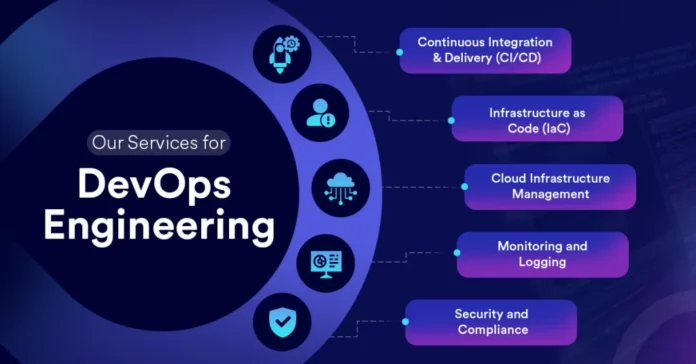
DevOps Engineering services cover automation, infrastructure management, monitoring, and security integration. Teams design CI/CD pipelines to ensure continuous deployment. Consequently, every code update passes through automated testing before release. Furthermore, engineers configure cloud infrastructure using code-based frameworks. This approach standardizes environments and prevents configuration drift.
Additionally, DevOps teams implement containerization technologies. They package applications with dependencies and deploy them consistently across systems. Engineers also establish monitoring dashboards to track performance metrics in real time. Therefore, they detect bottlenecks before users notice issues.
Security integration remains a key service area. Teams embed security checks into development pipelines. This practice reduces vulnerabilities early in the lifecycle. Moreover, DevOps specialists optimize resource allocation to control cloud costs. Businesses improve operational efficiency while maintaining performance standards. Through structured DevOps Engineering services, organizations ensure stable, scalable, and secure digital operations.
How DevOps Engineering Improves Business Efficiency
DevOps Engineering improves operational efficiency by automating repetitive tasks. Teams replace manual deployments with automated pipelines. As a result, they reduce delays and minimize human error. Furthermore, continuous testing identifies issues early in development. This process prevents costly rework later.
Additionally, teams collaborate in real time across departments. They share insights and resolve problems faster. Consequently, product releases become predictable and consistent. Engineers also monitor systems continuously. Therefore, they address performance issues before they escalate.
Businesses benefit from faster time-to-market. They respond quickly to customer feedback and evolving trends. Moreover, automation reduces infrastructure misconfigurations and downtime. DevOps Engineering aligns technical execution with strategic goals. This alignment increases productivity and lowers operational risk. Companies achieve greater efficiency without expanding team size. Over time, streamlined processes create measurable improvements in cost control, scalability, and service reliability.
How DevOps Engineering Enhances Scalability and Reliability
DevOps Engineering enables businesses to scale systems seamlessly. Engineers use cloud-native architecture to adjust resources dynamically. Consequently, applications handle traffic spikes without disruption. Furthermore, automated monitoring tools track system health continuously. Teams receive alerts and resolve issues immediately.
Additionally, infrastructure as code ensures environment consistency. Engineers replicate production environments accurately across regions. Therefore, they reduce configuration errors during scaling. Automated recovery mechanisms restore services quickly after failures. This strategy maintains uptime and protects brand reputation.
DevOps teams also implement load balancing and container orchestration. These technologies distribute workloads efficiently. Moreover, they conduct regular performance testing to validate system resilience. Businesses gain reliable digital operations even during peak demand. DevOps Engineering supports growth without compromising stability. Companies expand confidently while maintaining consistent performance standards and user satisfaction.
Strategic Business Advantages of DevOps Engineering
DevOps Engineering delivers strategic value beyond technical improvements. Businesses accelerate innovation by shortening development cycles. Consequently, they introduce new features faster than competitors. Furthermore, consistent deployment pipelines improve product quality. Customers experience fewer disruptions and smoother updates.
Additionally, DevOps practices foster cross-functional collaboration. Teams share responsibility and communicate transparently. Therefore, decision-making becomes data-driven and efficient. Leadership gains visibility into performance metrics and operational trends.
In the middle of this transformation journey, organizations such as Techstack Digital demonstrate how structured DevOps Engineering drives measurable outcomes. They integrate automation, cloud strategy, and performance monitoring into unified solutions. Moreover, companies reduce operational costs through optimized resource usage. Risk management improves due to proactive monitoring and continuous security checks.
Ultimately, DevOps Engineering aligns technology with business objectives. Enterprises strengthen market position, enhance customer trust, and build sustainable growth through streamlined digital operations.
Conclusion
DevOps Engineering redefines how organizations build and manage software. It removes silos and encourages collaboration. Furthermore, automation accelerates delivery and reduces errors. Additionally, continuous monitoring enhances reliability and scalability. Businesses gain agility and control over complex digital environments. They respond faster to market demands and customer expectations. DevOps Engineering creates measurable improvements in cost efficiency and operational stability. Companies that implement structured DevOps practices position themselves for long-term growth. In an increasingly competitive landscape, DevOps Engineering serves as a strategic foundation for innovation, resilience, and sustainable digital transformation.