


Table Of Contents
- Why Perfume Fades Over Time
- How Skin Moisture Affects Fragrance
- How Heat, Humidity, and Cold Change Wear
- A Simple Application Routine
- Using Clothing and Hair With Care
- How To Store Perfume Properly
- Common Fragrance Myths
- How To Test Fragrance Longevity
- Frequently Asked Questions
Few things are more frustrating than applying a favorite fragrance in the morning and feeling as if it has vanished by lunch. In many cases, the perfume has not completely disappeared. It has simply changed, softened, or become less noticeable to the wearer. Learning how to make perfume last longer starts with understanding what happens after the first spray.
Fragrance performance depends on the formula, your skin, the ambient temperature, clothing friction, and even how accustomed your nose becomes to the scent. Rather than automatically applying more perfume, a few deliberate habits can help you get a truer sense of its longevity and wear it more comfortably.
Why Perfume Fades Over Time
Perfume is a blend of aromatic materials that evaporate at different rates. The opening often features bright notes, such as citrus, herbs, or light fruits, which can be especially noticeable at first but may fade quickly. The middle of the fragrance then becomes clearer, followed by longer-lasting base notes that may include woods, musks, resins, or vanilla-like materials.
This evolution can create the impression that a perfume has disappeared when it has actually moved into a quieter stage. Research on fragrance evaporation from skin reflects the fundamental principle that fragrance materials do not all leave the skin at the same rate. A citrus-forward cologne may therefore feel brief compared with a deeper woody fragrance, even when both are performing as designed.
It also helps to separate three ideas. Longevity is how long the scent remains detectable. Projection is how far it travels from the wearer. Sillage is the scent trail left as someone moves. A perfume can have modest projection while remaining close to the skin for hours.
How Skin Moisture Affects Fragrance
Skin condition can influence how a fragrance feels over time. Very dry skin may not provide the same comfortable surface for scent as moisturized skin does, so some people find that a plain, fragrance-free moisturizer helps their perfume remain noticeable. Apply moisturizer first, let it settle, then add fragrance in a light layer.
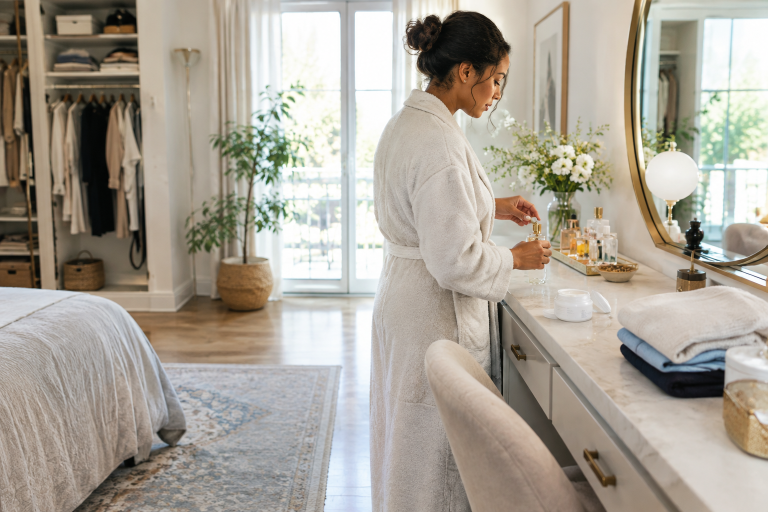
Avoid changing everything at once. If you introduce lotion, body oil, a new shower gel, and extra sprays all at once, it becomes difficult to tell which one made the difference. Test one adjustment over several wears. Skin moisture matters, but so do the perfume’s formula, the weather, fabric contact, and your activity level.
How Heat, Humidity, and Cold Change Wear
Warm conditions can make perfume seem stronger shortly after application because heat encourages aromatic materials to diffuse into the air. That does not always mean the scent will last longer. A fragrance may feel powerful during a summer commute, then seem much softer once you are in an air-conditioned office.
Humidity can also affect how a fragrance travels and how intensely it is perceived. In hot weather, lighter application is usually more comfortable, especially with rich or sweet scents. In colder weather, a fragrance may stay closer to the skin, making a careful extra spray or a slightly fuller style of scent feel more suitable.
A Simple Application Routine
- Begin with clean, dry, comfortable skin free from irritation.
- Use an unscented moisturizer first if your skin feels dry.
- Apply a small number of sprays to areas less likely to be constantly rubbed by clothing.
- Let the fragrance dry naturally rather than rubbing the skin together.
- Give it time to develop before deciding that it is weak. The opening is not the full dry-down.
- Reapply lightly only after checking whether the scent has truly faded.
Wrists, the inner elbows, and the sides of the neck are common choices, but there is no single placement that works best for everyone. If sleeves, scarves, jewelry, or frequent handwashing disturb one area, test another location instead.
Using Clothing and Hair With Care
Fabric can retain fragrance differently from skin, sometimes extending the scent trail. However, perfume may smell different on a sweater or jacket because it is not interacting with skin warmth and natural oils. Always test a hidden area first, particularly on pale, delicate, vintage, or expensive fabrics, since some fragrance products can mark materials.
For hair, products specifically designed for hair are generally the more cautious choice. Avoid spraying standard alcohol-based perfume directly into the eyes, onto broken skin, or onto sensitive areas. If a product causes burning, redness, or a rash, stop using it.
How To Store Perfume Properly
Store fragrance in a cool, dry, shaded place with a reasonably stable temperature. Sunny windowsills, steamy bathroom shelves, and hot cars expose bottles to heat, light, or moisture that can affect cosmetic products over time. The FDA advises keeping cosmetic containers closed tightly and discarding products when their color or smell changes.
Keep the cap on when the bottle is not in use, and watch for major changes in scent or appearance. A noticeably sour odor, an unexpected texture, or a significant color shift can indicate that it is time to stop using the product.
Common Fragrance Myths
More sprays always mean longer wear
More sprays can create a louder opening, but they do not necessarily improve the later dry-down. Overapplying may also make a scent overwhelming in close spaces.
Every fragrance should last all day.
Performance varies widely. Concentration is one clue, but ingredient choices, formula structure, climate, and individual wear conditions all matter.
If you cannot smell it, it is gon.e
Your nose can become less sensitive to a familiar scent after repeated exposure. Ask someone you trust for a brief opinion, or step away from the fragrance and reassess later.
How To Test Fragrance Longevity
- Test on clean skin rather than judging performance solely from a paper blotter.
- Record the time, placement, and number of sprays.
- Check after 15 minutes, two hours, four hours, and later in the day.
- Note changes in scent character, projection, and skin-level longevity.
- Repeat on another day, since weather and activity can change the result.
Frequently Asked Questions
Why does perfume fade faster on some people?
Skin moisture, body heat, activity, weather, clothing contact, and the fragrance formula can all contribute. Personal scent awareness can also make a fragrance seem weaker than it is.
Does moisturizer make perfume last longer?
An unscented moisturizer may help some people, especially those with dry skin. The most reliable approach is to test the same fragrance with and without moisturizer over several days.
Is eau de parfum always longer-lasting than eau de toilette?
No. Concentration can matter, but it is not a guarantee. The materials used and the way the fragrance develops on your skin are equally important.
Should perfume be sprayed on clothes?
It can be, provided you test the fabric first. Clothing may hold scent well, but it can also alter the fragrance and may be vulnerable to staining.
Final Takeaway
Better fragrance wear usually comes from small, repeatable choices: moisturize dry skin, apply with restraint, account for the weather, protect the bottle from heat and light, and allow time for the dry-down. A simple wear test will tell you far more about a perfume’s real performance than adding extra sprays.