


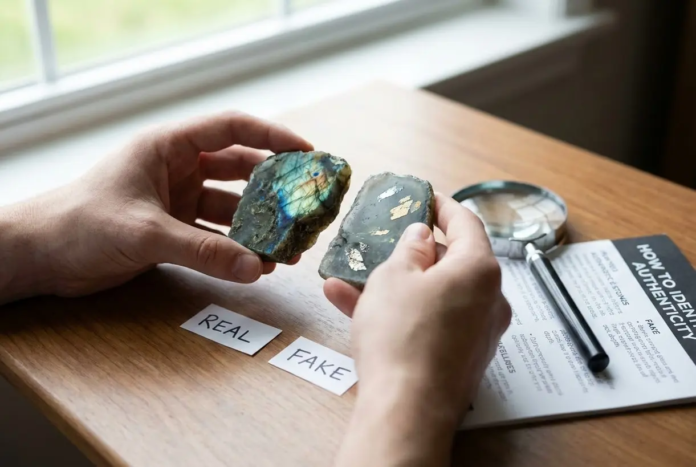
Labradorite is one of the dreamiest gemstones we know. From its glow to the way it looks, everything about this gemstone is admirable. That’s why it’s a popular choice for jewelry. However, some people also use this gemstone as it is for the healing practices. No matter how you choose to use it, the stone has to be real. That’s because only a natural labradorite displays that sheen and offers healing properties as well.
If you want to buy natural labradorite gemstones online, then knowing what a real stone is like becomes more important. In this blog, we will explore natural vs fake labradorite, so you can understand what you are exactly buying.
What Is Labradorite?
Labradorite is a feldspar mineral which is known for labradorescence. It is an optical effect where light diffracts off internal layers to flash blue, green, gold, or even purple hues. This gemstone is mined mainly from Canada’s Labrador region, Madagascar, and Finland (spectrolite variety). It forms in igneous rocks with a Mohs hardness of 6 to 6.5, making it durable yet scratch-prone.
When it comes to natural laboratories, these stones often appear gray or dark from one angle but ignite with color when tilted. From a healing angle, these stones stand for transformation in life.
Characteristics of Natural Labradorite
Genuine labradorite shows directional labradorescence. It means that colors emerge from within at specific angles. They can also shift or vanish as you rotate the stone under light. You can expect natural imperfections like inclusions, fractures, or cloudy zones that add authenticity.
The top specimens of labradorite display broad color bands over the surface. The stone feels cold to the touch, warms slowly in your hand, and has a rough, uneven texture on polished edges. It also contains flashes confined to certain “windows” rather than everywhere.
If a stone looks dull and has visible inclusions, chances are that it is a fake labradorite. That’s why it’s essential to get such stones from trusted platforms like GemstonesforSale. These brands specialize in natural gemstones only. Hence, you will get top quality stones without worrying about them turning out to be fake or low quality.
Common Types of Fake Labradorite
Fakes include glass coated with iridescent film, plastic molded with holographic foil, resin with embedded glitter, or dyed quartz mimicking sheen. Such cheaper imitations sparkle from every angle without depth. They are often too flawless or uniformly colorful. You can also come across many low-end fakes that use painted surfaces that chip over time. However, some synthetic and lab-grown versions of labradorite also exist. But they are rare. Most counterfeits of this gemstone target mass markets like beaded jewelry or slabs.
Visual Identification Tests
You have to tilt the stone slowly under natural or raking light. A real labradorite dulls in some views but flashes internally like moving plates. On the other hand, fake stones show constant surface sparkle. Another thing to check here is imperfections. Natural stones have veins or cracks, while fakes look unnaturally perfect or bubbly.
When shopping online, ensure to compare colors to photos of mined specimens. Avoid labradorite stones with overly vivid pinks or reds without blue-green. These are often dyed stones and not natural ones.
Hands-On Authenticity Checks
If you are buying a labradorite from a physical store, then you can conduct a touch test. Real labradorite conducts heat, feeling icy cold initially. On the contrary, plastics or resins warm instantly like room-temperature objects.
You can also gently scratch the stone with a steel knife (Mohs 5.5). The genuine ones resist without marking, but glass or soft fakes scratch easily. However, avoid harder tools to prevent damage. You can also perform a streak test. Generally, an unglazed porcelain yields white whereas colored streaks hint at dyes. Magnify edges for air bubbles or mold lines absent in naturals.
Advanced Gemological Tests
Measure refractive index (1.560-1.572) or birefringence with a refractometer. Fake labradorite stones deviate outside these ranges. Specific gravity (2.69-2.72) confirms density; lighter plastics fail here.
Another way to confirm the authenticity is through a UV light test. Under the UV light, a natural labradorite shows orange fluorescence, while coatings glow evenly or not at all. Polariscope reveals feldspar twinning patterns, which are unique to real stones. Professionals use these methods for certification.
Treatments vs Natural Stones
Treated labradorites often get heated, oiled, or coated to enhance color. They are more consistent than untreated naturals with subtle variations. Natural stones show deeper, less “perfect” flashes. On the other hand, treated ones have superficial sheen that fades. Ask sellers for disclosures as certified untreated pieces hold better value.
Final Words
Purchase from reputable sources like certified gem dealers or jewelers. They generally offer GIA/AGL reports that verify origin and enhancements, if any. Avoid bargains under $5 per carat for slabs. If the stone is available at an unrealistic discounted price, that’s a red flag.
You can expect to pay around $10-50+ for quality faceted gems. Also, if you prefer sustainable gemstone mining, go for Madagascar-sourced labradorite. In the end, it all comes down to that one stone that calls to you.